
Weeknotes: January 5–9, 2026
Monday, January 5
Driving west on Cross Street, there is a police barricade just past the Domino's Pizza. Typical Ypsi drama, I think, and detour around it. At the vacuum cleaner store I present two of my kitchen knives for sharpening. Why is that a combo — vacuums and knives? The woman in front of me is having a new motor installed in her KitchenAid mixer. I guess they do a little bit of everything.
I need to drum up a some cash for next week, so I spend the next hour Door Dashing. At La Marqueza Taqueria, Jodi B's order isn't ready yet, so I wait on a stool and listen to a young AT&T salesman make an awkward business pitch to the cashier. I get the sense that everyone in the room — even the salesman — is just waiting for it to be over. Despite the lateness of her order, I get a small tip from Jodi.
At home, I pull out the red plastic milk crate that holds all my percussion toys. I lay down shaker, maraca, tambourine, and vibraslap parts, but when I listen back, I realize I've accidentally left the monitors on — there's a ton of bleed and I have to track them all again. Meanwhile, my phone is blowing up. Behind that police barricade on Cross, a man with a sword is holed up inside his house after a neighborly dispute. When officers first arrived at the scene, he brandished his weapon at them. The standoff has now exceeded 20 hours. Typical Ypsi drama.
Tuesday, January 6
A rough day. Not awful, just rough. All the lovely snow evaporates into a diffuse gloom that never lets up. I’m back at work, but my energy hasn't returned and I'm still coughing. A morning Telehealth session with my doctor nets me an amoxicillin scrip and a journey out into the gloom to fetch it. At the pharmacy, I shuffle under the fluorescent glare with the other pale winter ghosts. It feels like the Afterlife Counseling Center from Beetlejuice. Underlying it all is the unrelenting daily anxiety of Trump's America, wearing us down to the bone. A national illness.
I won't stay bitter for long. Tomorrow will sort itself out, but tonight I need some escapism to pull me out of my funk. Somehow, I missed The Fabelmans, when it first came out. Steven Spielberg's semi-autobiographical origin story is the kind of American coming-of-age tale I love — "You do what your heart says you have to, because you don't owe anyone your life."
When David Lynch makes his cameo as John Ford in the final scene, I cry happy tears. Lynch died almost one year ago. It's spectacular.
Wednesday, January 7
Today is Tony Brogger's birthday. He would have been 56. Tony died of a heart attack in August 2020, during the pandemic. It seems a grim irony that I lost three friends to heart attacks during that period. His death was both surprising and not — he was grossly overweight and had battled depression for years. We hadn't spoken in a while, but every year he and I had a tradition of leaving each other voice messages on our respective January birthdays.
Tony was seven years older than me, closer in age to my brother, with whom he had a fascinating relationship — musically prodigious, but increasingly fraught as time went on. We grew up a few houses away and played football in his front yard. Just a bunch of Midwestern neighborhood kids from the suburbs. From about 1986 onward, he was known as the Gok, an unlikely creative figurehead around whom we constructed vast, intricate mythologies. The strange, hilarious music he and my brother made together is so deeply ingrained in my consciousness that I have difficulty describing it.
Early on, it involved my brother playing some sort of programmed Casio sequence while Tony riffed into a Radio Shack mic with absurdist savant brilliance. After my brother acquired his first four-track, the arrangements became more elaborate as he developed his own musical craft. In a span of about 15 years, at least two dozen 90 minute tapes were filled and traded among a close-knit group of friends. As I grew older, I became more involved in the process, though the essence of it was always Jamie and Tony. Eventually, Jamie and I started our own band, the Original Brothers and Sisters of Love (named of course after a Gok song), and began our careers in earnest. The last Gok album was made in 2002.
His music survives on hard drives and cassette tapes, but has never seen any sort of proper release. It might stay that way — it's not my call to make. Nonetheless, he had a massive impact on me as a kid and subsequently as a creative person. It was my musical education.
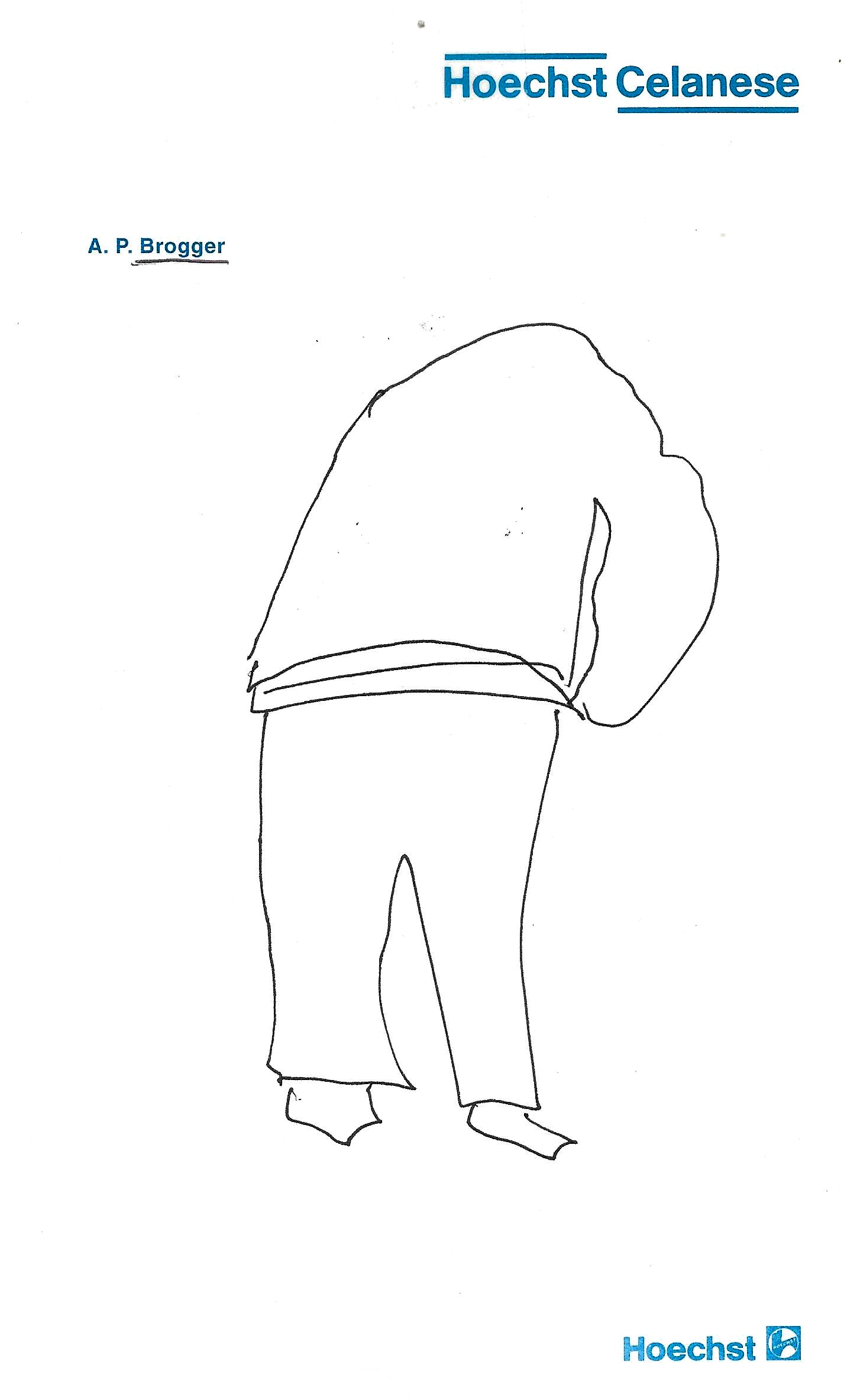
Last week, I came across this drawing I made of the Gok on a business notepad in his parents' kitchen, probably sometime in the late-'90s. His dad was also named Anthony Brogger. We all liked to draw funny characters, but somehow I see the real Tony in this picture, hunched over the kitchen counter with a beer.
Thursday, January 8
Esteban will have nothing to do with the fancy bed I got him for Christmas, nor the fluffy bathmat I laid across the heating vent where he hangs out. Right now he's sprawled just next to it on the hardwood floor, inches from comfort. Cats will be cats.
After work, I spend a pleasant hour revisiting an instrumental track I started back in 2017. Two of its main parts were made on a Casio CTK-518, a keyboard I found in someone’s front yard during a run and carried home to make good use of. I later sold it, along with another smaller Casio, to buy some other gear and now regret it. I don't have room for any more full-sized keyboards, but I'm down to just two Casios. How can I respect myself?
Friday, January 9
I'm listening to Julian Cope's eco-psych-punk classic, Peggy Suicide. It's one of several influential discs my brother brought home from college in 1991. Born four years apart, he and I shared parallel freshman years — mine at Brighton High School, which he had just departed, and his at Central Michigan University, where I would later join him. He had already been funnelling the "good stuff" (the Pogues, Pixies, Camper Van Beethoven, Love & Rockets) my way since about 1987. Having a cool older sibling does wonders for one's early cultural development. At least in the pre-internet era.
I’ve probably already written about this, but at that point, I really only knew Cope's lone pop hit, "World Shut Your Mouth," a highlight of 120 Minutes-era MTV. Peggy Suicide was a complete reinvention and ignited a run of iconoclastic albums that includes his masterpiece, Jehovakill, the shambling Autogeddon, and 20 Mothers, which came out the year I started college. I bought it at New Moon Records in Mount Pleasant, which reeked of nag champa incense and sold the requisite hacky sacks, Baja ponchos, and Bob Marley posters that were the common accessories of the ‘90s college kid.
I listened to 20 Mothers — a personal favorite — a couple days ago and was transported back to 1995 and my one misguided year (until recently) of college. I have a sudden flashback of Jamie and I driving from Mount Pleasant to Grand Rapids in his grungy old Chevy Corsica to go record shopping. I was drinking a Nesquick. Cope blasted out the cracked window from which Jamie smoked in the cold mid-Michigan afternoon. He and I both dropped out the next summer and moved home to form the Original Brothers and Sisters of Love.