


Weeknotes: March 30–April 3, 2026
Monday, March 30
The young college DJ announces she'll close out her afternoon show with They Might Be Giants' "Birdhouse in Your Soul," an old favorite of mine. There's a period of dead air, followed by about ten seconds of the song's intro, then more dead air. An acoustic guitar track I don't recognize makes a couple false starts, then after another long gap Arcade Fire's "Sprawl II" begins to play. A change of heart, I think, but no — it too goes quiet. An additional seven or eight seconds of dead air (an eternity on radio), then finally, the marquee event: "I'm your only friend, I'm not your only friend, but I'm a little glowing friend…"
There was a time when I would have turned the dial, but I've been so smitten with WCBN lately. As AI becomes more intrusive and our trust in the authenticity of content erodes, I think we are instinctively attracted to what feels human. You can't fake inexperience. Hearing someone fumbling around learning the ropes on live radio gives me more pleasure than the edgeless infinity of algorithmic curation.
A few hours later I'm sitting on a lawn chair outside the back door, squinting at my laptop and enjoying the warm sunny afternoon. Islay stands next to the Mexican blanket I laid out for her, browsing a menu of sticks to eat. All of a sudden a wild turkey runs around the side of the house, sees her, and vaults itself noisily over the back fence. My dog is unphased, but a minute later she goes crazy barking at a guy walking by out front. I wave hello and he asks "did you just see a turkey?"
Weeknotes: January 12–16, 2026
Monday, January 12
Winter semester starts bright and clear. On WCBN, the DJ is playing a block of Bowie tunes — "Cat People (Putting Out Fire)," "Look Back in Anger," "Heroes." Great Lakes Myth Society recorded a cover of "Look Back in Anger" many years ago with our friend Stirling, but it was never released. It was produced by Mike E. Clark of Insane Clown Posse fame.
I feel anxious about so many things lately, but today I'm nervous about the amount of work I'm taking on. Career, school, gigs, recording projects, this blog. I've been able to maintain it all well enough over the past two years, but the classes are getting more advanced and I'm not good at removing tasks from my life. I only ever seem to add more. There's a lot of winter left — I have to make sure it's not a joyless slog.
I pull into a parking spot behind a silver sedan whose license plate frame reads "I'm Speeding Because I Have to Poop."
Weeknotes: November 3–7, 2025
Monday, November 3
It's hard sometimes to play fast, but we are a rhythmic species — if you practice enough, a fast part usually comes together nicely, at least in my experience. I think it's much tougher to play slowly. When there is more space between the beats, you have nowhere to hide — each note carries more weight and a whole menu of nuance opens up.
I've been trying to make some music that is very minimalist with few elements and plenty of negative space. The piece I'm working on is for two fingerpicked guitars, one playing a repeated chord pattern at a relaxed tempo and the other playing a very deliberate single note lead melody. More often than not, this is the kind of music I listen to around the house: sparse Nordic jazz records from ECM, solo acoustic guitar albums, ambient synth music, etc.
Most of the music I've released has been densely-arranged songwriter pop with clever arrangements, layered harmonies, and lots of percussion. I will make more of that, but I also want to challenge myself to see if I can scale down and still keep it interesting. It's making me a better, or at least a more thoughtful guitarist. Because there are no vocals and just one or two instruments, I'm thinking very hard about every note and asking questions like:
What part of my finger yields the best tone for this note?
If I can't finish this part today, will my fingernails be too long and sound slightly different tomorrow?
How long should I let these overtones ring?
Do I slide up to this note or hit it dead on?
A bit of vibrato heading into the rest?
Weeknotes: July 14–18, 2025
Monday, July 14
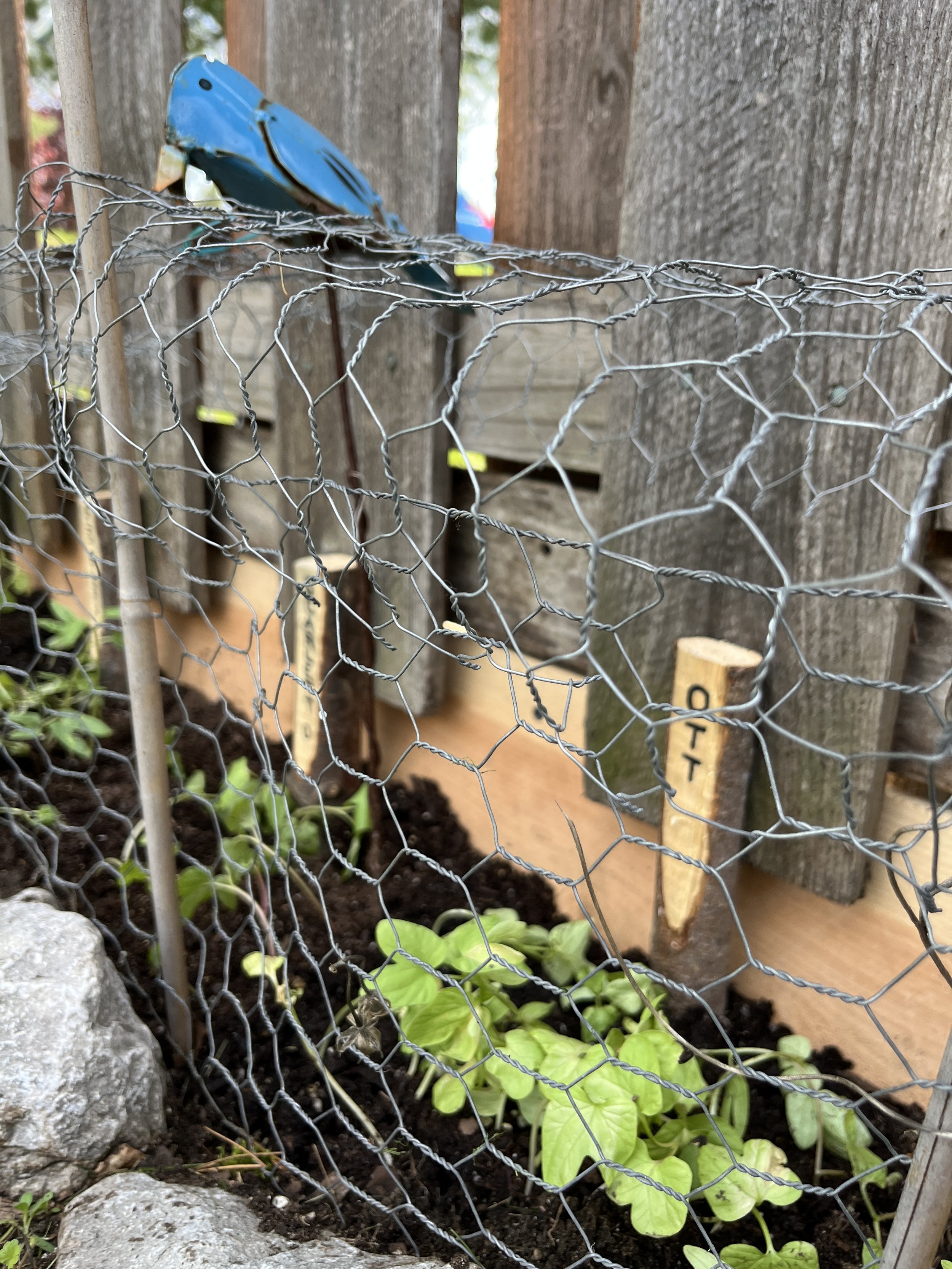
The aggressive plant growing up the side of my house is a trumpet vine. I didn't plant it, but I've watched it multiply over the past few years until it finally produced a series of red trumpet-like blossoms. I didn't know what it was until I saw those same flowers in the community garden at Frog Island Park and finally looked it up. At least it’s native.
Through the haze of Canadian wildfire smoke I walk up to a brewpub to read my Icelandic detective novel in which the characters are suffering similarly smoky skies from a volcanic eruption. Up the gravel track through Frog Island, a man is stretching his legs on the soccer pitch and blasting Latin music from a boombox. At the other end a group of kids are sitting cross-legged on the concrete amphitheatre stage. Apart from the smog, it's a perfectly lazy summer night in Ypsilanti. I think about how happy I've been living in this town over the past four years.
Inside the brewery a man is speaking to a packed house. A keyboardist sits behind him. I order a beer and ask the bartender what's up. "It's opera night. We're actually closed for a private event, but I'll serve you." The man begins singing and I escape out the side door to sit in the little beer garden overlooking a very subdued Depot Town. Two tables away a woman is quietly crocheting some type of garment. Otherwise, the place is deserted. I read my book and people-watch. A train passes. A mezzo soprano threatens the glass window. There’s a round of applause. It’s a soothing blend of sounds.
Walking home along the ridge I notice how low the river is. Out in the thigh-deep channel a fly fisherman casts his line. To my right, down in the park, two dogs run full tilt across the fresh cut grass.
Weeknotes: May 5 – 9, 2025
Monday, May 5
I'm spending another morning with Pink Floyd, this time working on a review for the Live at Pompeii soundtrack that came out last Friday. I re-familiarize myself with some biographical material and stumble upon their early single "Point Me at the Sky." I'd completely forgotten about this song, a fantastic bit of late-'60s psych-pop with shared vocals between David Gilmour and Roger Waters. I loved it when I was young, though it was a rarity that could only be found on bootlegs. I credit Wazoo Records in Ann Arbor with introducing me to the bootleg scene. They had a special cassette section where, if you knew what you were looking for, you could find strange compilations of unreleased live material, non-album tracks, and other oddities from a multitude of artists.
I still have a David Bowie compilation with a photocopied cover that includes a version of him singing "All the Young Dudes," the song he wrote for Mott the Hoople which, incidentally, was the first song I ever learned how to sing and play on guitar. I'd been playing for a couple years by that point, but didn't yet fashion myself a singer. I was about 12 when my guitar teacher, Mike Lutz, taught me how to play "All the Young Dudes," and it was the most complex chord sequence I'd learned to date. I remember feeling a great sense of satisfaction once I'd managed to separate my unformed voice from my strumming which felt like a creative version of patting your head while rubbing your belly. Before that, I assumed I'd be the guitarist in a band with someone else acting as lead singer, as was the custom in most of the hair metal bands I listened to at the time. Being able to handle both was a revelation to me. I can see now that I've followed that path ever since. I love collaboration, but if I can find a way to take care of something on my own, that's how I will probably do it.
Later on, I take my guitar to the luthier for what I've now accepted to be its regular seasonal adjustment. I've had this Martin 000-15M for two years now and its mahogany body is so much more sensitive to humidity and weather shifts than my old birdseye maple Shenandoah. I played that guitar hard for 30 years and, apart from replacing the bridge about ten years in, barely ever had it worked on. It's as sturdy as they come. The new 000-15M fluctuates all over the place, though when the action is right, it's a joy to play and hear. I hope it settles into itself at some point, just like I did.
Weeknotes: March 3–7, 2025
Monday March 3
I'm on Spring Break. The last time that happened was 1997, by which time I'd already been a college dropout for a year. I joined a group of friends on a weeklong trip to Hilton Head, South Carolina where we drank impressively and agitated the local retiree populace as only drunken youth can.
This year, my friend Serge invited me on a weekend road trip to Newport, Kentucky to see Robyn Hitchcock at Southgate House Revival. It’s the successor to the late Southgate House, a grand old pile that for decades served as a staple of the indie rock touring circuit until its abrupt closure in 2011. GLMS played a show there sometime in the mid-2000s, though my memories of it are hazy. We opened for an Oregon band called the Stars of Track and Field in the tavern room and played mostly to the staff. We might have caught a couple strays who wandered in for a beer, but neither band had any fans there. Somewhere there's a photo of me in one of my occasional touring moustaches posing next to an oil portrait of some colonial chap who may or may not have been the manor's original inhabitant.
The revival occupies an old church just a few blocks away and carries some of the original’s historic gravitas, even if it feels like a work in progress. But, a santuary seems like a good fit, especially for Hitchcock who was in top form. His set consisted almost entirely of requests, a detail I didn't learn about until I overheard his partner, Emma Swift, asking fans at the merch booth if there was anything they'd like to hear. I can hardly remember the songs I've just practiced, let alone dredge up curios from the distant past; this gig would be my nightmare. In fact, I've probably had this nightmare. But Robyn was game, and as a result I got to hear songs I never thought I'd hear live, foremost among them the timely "Don't Talk To Me About Gene Hackman," a cut so deep it was the second of two unlisted secret tracks buried at the end 1999's Jewels For Sophia. He closed with the Soft Boys gem “Queen of Eyes,” a song I’ve included in my own set many times. As an encore, he unplugged his guitar and paced around the congregation leading a sing-along of the Beatles’ “A Day in the Life.” My kind of sermon.
The next day we drove an hour east to see the great Serpent Mound, a 1,348-feet-long effigy built thousands of years ago, probably by the Adena culture. The gates were closed when we arrived, so we took our chances and trespassed on foot. Relative to this country's size, America has preserved so few of these ancient earthworks. Past a small visitor center and rickety observation tower (closed for repairs) the curving burial mound stretched serenely out of view, bordered by a paved footpath. With no one else around, it seemed especially peaceful and we grokked it with reverence for its prehistoric creators and apologies to its present-day stewards, the Ohio History Connection.

Weeknotes: November 18–22, 2024
Monday, November 18
It's mid-afternoon and I'm standing at the end of my block with Islay who is examining a hedge. Across the street a band loads out of an upstairs apartment. The first guy has a freshly-sculpted mohawk and a guitar case and is followed single file by two mismatched bandmates with amps and drum gear.
At work we are assembling our year-end lists, both for the company and as individual editors. I have some focused listening to do. At dusk I head out on foot and find myself wandering though Highland Cemetery, listening to Arooj Aftab's Night Reign on my headphones. It's a good cemetery album, more seductive than spooky. As night falls, I see a woman walking a dog in my direction down the dark wooded lane and turn around so as not to scare her. On my way out I pause at the gate which is eerily lit by a high purple streetlight. Now I'm listening to the Shovel Dance Collective, a U.K. folk group who sound a bit like Ireland's Lankum. Their slow, brooding version of the old maritime ballad "The Merry Golden Tree" is a bit of a masterpiece. I love these new dark trad bands.
Weeknotes: July 29 – August 2, 2024
Monday, July 29
It's midday and my brother and I are driving up US-23 to Fenton in a borrowed truck. He puts on a low-key electronic mix that reminds me of Ulrich Schnauss' Far Away Trains Passing By, an album we both agree is the ideal downtempo vibe. We're picking up a couch our parents bought from a local furniture store to save them the shipping cost. Simultaneously, we both get a text from our boss. I'm driving, so Jamie reads it to me. Drama at the office. Six of our co-workers have been laid off amid a larger company-wide restructuring. Somehow, we have both survived another corporate culling, though it's hard to feel secure right now.